MBTI Cognitive Functions in Relationships: Why Your Type Stack Matters More Than Your Letters
Your four-letter MBTI code is the summary. Your cognitive function stack is the story. Discover how Ne, Ni, Se, Si, Te, Ti, Fe, and Fi create the real dynamics in your relationships.
What MBTI Cognitive Functions Actually Are
You already know your four letters. You've told dates "I'm an INFJ" over coffee, used it to explain why you need three days to recover from a party, and probably sent at least one "MBTI compatibility chart" to a friend. But if you've ever thought this doesn't quite explain why my ENFP partner and I keep having the same argument about nothing, the four-letter code isn't where the answer lives.
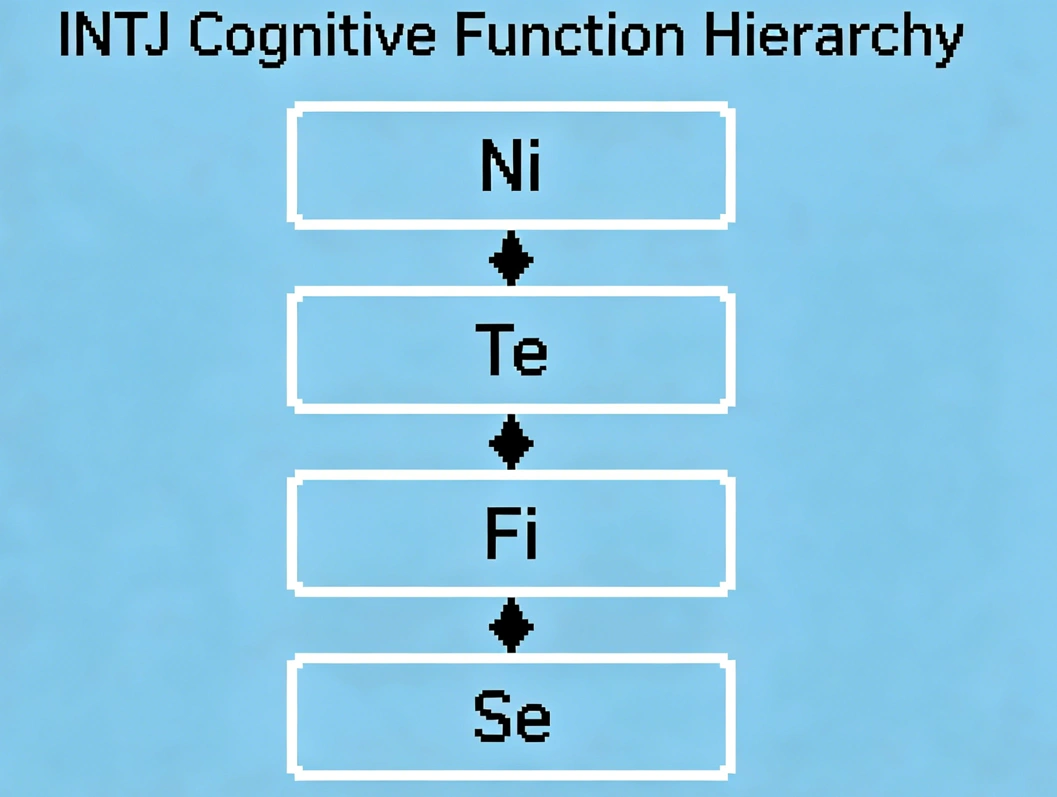
The answer is in your cognitive function stack — the actual mental wiring that determines how you take in information, make decisions, and interact with other people. Two people can share three out of four letters and still clash in ways that feel weirdly personal. Two people with zero letters in common can fall into a rhythm that makes everything feel easy. The letters are the summary. The functions are the story.
Carl Jung proposed that people don't just differ — they process the world through fundamentally different mental operations. There are eight of them: four perceiving functions (how you gather information) and four judging functions (how you make decisions). Each function can be directed inward (introverted) or outward (extroverted).
The perceiving functions:
Ne (Extroverted Intuition): pattern-spotting across possibilities, connecting unrelated ideas, brainstorming without needing to land
Ni (Introverted Intuition): convergent insight, synthesizing toward a single vision, the "I just know" feeling
Se (Extroverted Sensing): full engagement with the physical present moment, noticing what's actually happening right now
Si (Introverted Sensing): comparison to past experience, reliability, the pull toward what's familiar and proven
The judging functions:
Te (Extroverted Thinking): external logic, systems, efficiency, measurable outcomes
Ti (Introverted Thinking): internal consistency, precision, building private frameworks that have to make sense on their own terms
Fe (Extroverted Feeling): attunement to group harmony, reading emotional temperature in a room, adjusting for others
Fi (Introverted Feeling): personal value alignment, the deep internal "this is right/wrong for me" sense
Every MBTI type uses all eight functions, but four are more developed — and within those four, there's a hierarchy: dominant, auxiliary, tertiary, inferior. Your dominant function is your most natural mode. Your inferior function is the one that tends to fail under stress in embarrassing and recognizable ways.
How Function Stacks Create Relationship Dynamics
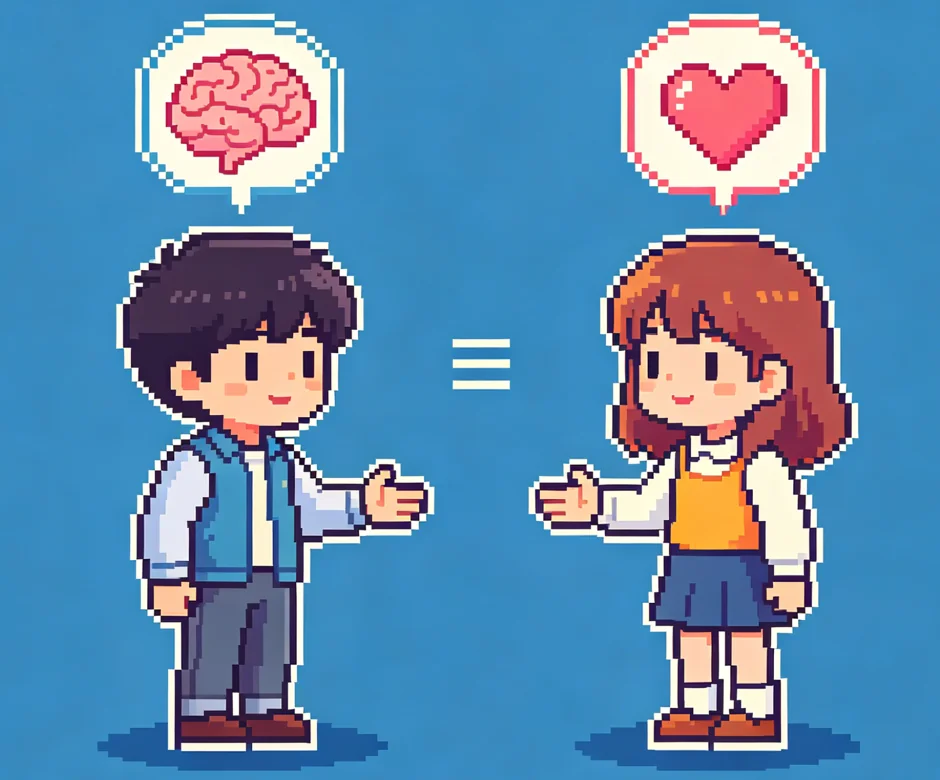
The dynamic between two people in a relationship isn't really about type labels. It's about which functions are engaged, and whether they're speaking the same cognitive language — or two completely different ones.
Ne–Si Tension (and Partnership)
Ne users (ENFPs, ENTPs, INFPs, INTJs at lower positions) are constantly generating new possibilities. They resist closing down options. They get genuinely excited by pivoting mid-conversation to a better idea.
Si users (ISFJs, ISTJs, ESFJs, ESTJs) anchor to precedent. They trust what's been tested. Deviating from an established system isn't creativity to them — it's risk without justification.
In a relationship, this creates a specific recurring conflict: the Ne user feels constrained and unheard; the Si user feels destabilized and disrespected. Neither is wrong. They're operating on completely different assumptions about what "making good decisions" looks like.
What makes this pairing actually work — and many Ne/Si pairings do — is role clarity. Ne users bring the vision; Si users catch what the vision misses. If both people understand what the other is doing rather than just experiencing it as opposition, the dynamic shifts from friction to balance.
Ni–Se Tension (and Partnership)
Ni is directional. Ni-dominant types (INTJs, INFJs) are moving toward a conclusion — they've already synthesized the data and have a strong internal sense of where things are heading. They can be frustrating to argue with because they can't always explain how they know what they know.
Se is immediate. Se-dominant types (ESFPs, ESTPs, ISFPs) are grounded in what's present and real. Abstract future-forecasting reads as overthinking or detachment.
The relationship challenge here is presence vs. vision. The Se partner wants engagement with now — this conversation, this dinner, this moment. The Ni partner is often somewhere else in their head, processing. This reads as distance even when it's not disinterest.
When this pairing works, it's because Se draws Ni out of their head and into lived experience; Ni gives the Se partner a sense of meaning and direction beyond the immediate. They need each other's strengths, which is a good foundation — but it requires deliberate translation.
Fe–Fi Tension (and Partnership)
This is one of the most common sources of relationship misread. Fe and Fi are both emotional functions, but they operate so differently that people using them often feel like they're in completely different conversations about the same event.
Fe users (ENFJs, ESFJs, INFJs, ISFJs) process emotion relationally. They feel the emotional temperature of a room and adjust to it. Harmony is genuinely important to them — not as a performance, but because discord is something they physically feel. When someone is upset, their instinct is to help that person feel better, which sometimes means softening the truth.
Fi users (ENFPs, ESFPs, INFPs, ISFPs) process emotion internally. Their moral compass is private and deeply personal. They don't automatically adjust to social expectations — they check in with their own values first. When something violates their sense of what's right, they feel it as a personal offense even if no one else noticed.
The conflict that emerges: an Fe user might reframe a problem to reduce conflict; a Fi user experiences this as dishonesty. A Fi user might hold a strong personal position that seems inflexible to an Fe user who's trying to find common ground. Each experiences the other's approach as slightly missing the point.
What they can offer each other: Fe users help Fi users consider the relational impact of their positions; Fi users help Fe users stay honest when they'd rather smooth things over.
Te–Ti Tension (and Partnership)
Te users (ENTJs, ESTJs, INTJs, ISTJs) want decisions to produce results. Efficiency, external evidence, systems that work — these are the metrics. Discussions that don't move toward a conclusion start to feel like a waste of time.
Ti users (INTPs, ISTPs, ENTPs, ESTPs) want decisions to make internal sense first. They're less concerned with whether something is efficient and more concerned with whether it's correct. They'll hold up a decision-making process to examine a premise that everyone else had already accepted.
In relationships, Te users sometimes experience Ti users as obstinate or impractical. Ti users experience Te users as rushing past important questions because they're too focused on outcomes. The underlying issue is that they're using different success criteria for the same conversation.
The Inferior Function: Why Stress Ruins Everything
Every MBTI type has an inferior function — the weakest, least-developed position in their stack. Under stress, people don't access their best functions. They fall into their inferior function, which shows up as an exaggerated, clumsy version of something that wasn't their strength to begin with.
An INTJ's inferior Se, under stress, becomes obsessive focus on physical details — suddenly fixated on every possible way their environment might be wrong. An ENFP's inferior Si, under stress, becomes paranoid certainty that past patterns mean everything will fail. An ISFJ's inferior Ne can spiral into worst-case scenario thinking, generating anxious possibilities everywhere.
Why this matters in relationships: stress responses often look like personality transplants to a partner who's used to someone's best functioning. The person who's usually calm and analytical becomes weirdly obsessive about minor details. The person who's usually open and enthusiastic becomes convinced nothing will work out.
Recognizing your partner's inferior function pattern — and your own — is one of the more useful things you can do for a relationship's long-term stability. It's not about making excuses. It's about having a framework for "something has triggered their stress response" rather than "they've become a different person."
Which Pairings Create Natural Cognitive Resonance?
There's a concept in MBTI theory called "cognitive function mirrors" — pairings where each person's dominant function is the other's auxiliary, creating a kind of natural complementarity. Classic examples:
INFJ + ENFP: INFJ leads with Ni (directional insight), with Fe as auxiliary. ENFP leads with Ne (expansive possibility), with Fi as auxiliary. They share the Ni/Ne orientation toward intuition and meaning, but express it differently — INFJ converges, ENFP expands. In conversation, this often feels like someone finally understanding your language.
INTJ + ENTJ: Both are Ni/Te users, just in different hierarchy. They tend to understand each other's reasoning style with unusual efficiency. Risk: they can become too aligned to challenge each other well.
ISTP + ESTP: Both Ti/Se, different dominant positions. Strong practical resonance. Possible friction: neither prioritizes the relational/emotional processing that Fe and Fi users build naturally.
INFP + ENFJ: Fi dominant (INFP) meets Fe dominant (ENFJ). The INFP brings personal authenticity; the ENFJ brings relational attunement. Can be deeply nourishing, can also create a dynamic where the ENFJ over-adjusts to the INFP's emotional needs at their own expense.
None of these are predetermined to work or fail. They're just descriptions of which cognitive conversations will come easily and which will require more deliberate effort.
The Shadow Functions and Long-Term Relationship Growth
There's a less-discussed layer to cognitive function theory: every type also has four "shadow" functions — the inverse of each primary function. These shadow functions operate largely outside conscious awareness, and they tend to emerge in situations of stress, projection, or conflict.
Every primary function has a shadow inverse: Ne's shadow is Ni (and vice versa), Se's shadow is Si, Fe's shadow is Fi, and Te's shadow is Ti. Your shadow stack consists of the same four functions as your primary stack, but with each orientation flipped — the four functions that sit outside your natural psychological domain. Shadow functions operate unconsciously. They're not absent; they're just beyond the reach of normal deliberate use. Under stress, when primary functions fail, shadow functions emerge — but without the developed skill of the primary stack. The result is a version of yourself that feels foreign, uncomfortable, and often destructive.
The shadow of Fe is Fi — so an ENFJ under pressure, who usually attunes to group harmony through Fe, may suddenly become rigidly individualistic and resentful, acting from Fi in a way that surprises people who know them as warm and flexible. The shadow of Ti is Te — an INTP who usually builds intricate internal frameworks through Ti may, under sustained pressure, swing into blunt Te mode: demanding results, getting impatient with nuance, functioning in a way that looks more like an INTJ than themselves.
Why does this matter in relationships? Because shadow function behavior tends to look like the person's supposed worst match acting through their body. The most common place shadow functions surface is in intimate relationships — specifically, in conflict.
The INFJ in Shadow
An INFJ's primary stack: Ni, Fe, Ti, Se. Shadow stack: Ne, Fi, Te, Si. Normal INFJ in a relationship: reads emotional dynamics with uncanny accuracy through Fe, creates meaning and long-range vision through Ni. INFJ under severe relational stress: the Ne shadow produces wild, unfounded speculation — catastrophizing based on tenuous pattern-matching, constructing elaborate bad endings from minimal evidence. The Fi shadow makes them rigidly individualistic and oddly self-focused. The Te shadow makes them blunt, cold, and procedural — listing grievances like items on an invoice.The ENTJ in Shadow
An ENTJ's primary stack: Te, Ni, Se, Fi. Shadow stack: Ti, Ne, Si, Fe. Normal ENTJ: direct, strategic, forward-oriented. ENTJ in shadow: Ti shadow produces pedantic, hair-splitting logic — arguing about definitions rather than addressing the actual issue, winning the debate while losing the relationship. Ne shadow generates anxiety about multiple competing possibilities when they need decisiveness most. Fe shadow is the most striking: suddenly emotionally reactive and interpersonally manipulative — passive-aggressive, tearful, or clinging where they normally project invulnerability.The ISFP in Shadow
An ISFP's primary stack: Fi, Se, Ni, Te. Shadow stack: Fe, Si, Ne, Ti. Normal ISFP: deeply values authenticity, present-focused, emotionally independent. ISFP in shadow: the Fe shadow makes them suddenly attuned to group opinion and approval — seeking external validation in a way that contradicts their normal independent Fi stance. The Si shadow makes them rigidly past-focused, citing precedents and replaying old grievances. The Ti shadow produces cold, system-based analysis of the relationship as if it were a problem to be solved rather than a person to be known.The ENTP in Shadow
An ENTP's primary stack: Ne, Ti, Fe, Si. Shadow stack: Ni, Te, Fi, Se. Normal ENTP: generative, debate-loving, quick-connecting. ENTP in shadow: the Ni shadow produces paranoid certainty — the normally possibility-rich mind collapses into a single terrible interpretation and defends it against all evidence. The Te shadow makes them uncharacteristically blunt and authoritarian. The Fi shadow is the most unfamiliar: suddenly deeply wounded about something that seems minor to everyone else, operating from a private value system they can't or won't articulate.The shadow cycle in relationships tends to follow a recognizable four-stage pattern. Stage 1 — Trigger: something happens that the primary functions can't process — sustained pressure, feeling fundamentally misunderstood, or a threat to the relationship's stability. Stage 2 — Escalation: the primary functions work harder and less effectively. An Fe-dominant type tries even harder to smooth things over; a Te-dominant type pushes for resolution with increasing pressure. Stage 3 — Shadow activation: the primary strategy collapses. The shadow stack takes over. The normally warm Fe-dominant person becomes cold and critical; the normally logical Ti-dominant person becomes emotionally explosive. Stage 4 — Return and confusion: stress drops, the shadow recedes, and the person often genuinely doesn't fully recognize their shadow behavior as their own. The problem: to their partner, it absolutely was them.
The disorienting thing about shadow activation is that it looks like a personality transplant to the person on the receiving end. Partners who don't understand shadow dynamics tend to interpret these episodes as proof that the person is fundamentally different from who they presented. Understanding shadow behavior doesn't mean excusing it — but understanding it creates a much more productive conversation than "you're a completely different person and I don't know who you are."
Practical application: if you know your type's shadow functions, you have a vocabulary for your own worst-case behavior. You can warn a partner in advance. You can recognize when you've slipped into shadow mode and name it rather than defend it. This kind of self-aware disclosure is one of the things that distinguishes mature MBTI engagement from the Twitter "I'm an INTJ, we don't do emotions" version.
Working With Shadow Dynamics in a Relationship
The most useful thing you can do with shadow knowledge in a relationship context is develop a vocabulary for it before you need it.
Learn your own shadow stack. Find your type's four shadow functions and read descriptions of what they look like under stress. The goal isn't to become fluent in the shadow — that's not how it works — but to recognize the early signs that you're moving toward it.
Identify your activation pattern. What conditions push you toward shadow? Sustained conflict? Feeling invisible? Loss of control? Chronic uncertainty? Each type has a characteristic shadow-activation signature. Understanding yours means you can name the conditions before you've fully entered shadow mode.
Communicate the conditions to your partner. "When I feel like nothing I say is landing, I go somewhere kind of dark — I get cold and my logic gets pedantic. That's not me processing clearly. It's me out of resources." This kind of disclosure is more useful than apologizing after the fact.
Develop a circuit-breaker. What brings you back from shadow? For most people, it involves removing the activating stressor — space, time out, physical change of environment — rather than working through it in real time. Trying to resolve the conflict while one person is in shadow mode tends to make things worse.
Don't take shadow behavior as the relationship's truth. What someone says and does in shadow mode is information — but filtered information. It reflects their deepest fears and unmet needs more than their actual assessment of you or the relationship. Treating shadow-mode declarations ("this isn't working"; "you never actually cared"; "I don't know why I'm with you") as final is usually a mistake.
The therapeutic goal in most depth psychological traditions is integration — not eliminating the shadow but developing enough relationship with it that it doesn't take over without warning. In MBTI terms, this means gradually developing skill in the less-familiar functions, not by abandoning the primary stack but by expanding the range. An INFJ who has done significant inner work can access Ne without it producing paranoid spiraling. An ENTP who has genuine Fi development doesn't experience the Fi-shadow intrusion as something entirely alien — they have enough familiarity with the function to recognize what's happening and partially redirect it.
This is a long process and it's rarely linear. But in relationships, even partial integration produces a disproportionate improvement in conflict management. The difference between "I completely lose myself when this person triggers me" and "I notice when I'm moving toward that state and can sometimes catch it" is enormous in practical terms. Partners who understand each other's stress signatures are in a substantially better position than those who only know each other's type.
When Shadows Collide: Cross-Type Stress Patterns

Some MBTI pairings produce particularly consistent patterns when both people are in stress mode simultaneously — not because those types are incompatible, but because their stress signatures interact in specific ways.
Fe-dominant + Ti-dominant under mutual stress: The Fe-dominant person (ENFJ, ESFJ, INFJ, ISFJ) pushes for emotional resolution and connection — but from their Fe-shadow, which looks like Fi: suddenly self-focused, privately wounded, and unable to articulate what they need. The Ti-dominant person (INTP, ISTP, ENTP, ESTP) pushes for logical precision — but from their Te-shadow: blunt, authoritarian, demanding compliance rather than understanding. Both people are trying to process the conflict using the shadow of their strongest function. Neither one sounds like themselves. Neither one recognizes the other.
Ni-dominant + Se-dominant under mutual stress: The Ni-dominant person (INTJ, INFJ, ENTJ, ENFJ) normally builds coherent long-range visions. In shadow, their Se-inverse takes over: suddenly present-focused in a reactive, overwhelmed way, unable to access the strategic clarity that's usually their greatest asset. The Se-dominant person (ESTP, ESFP, ISTP, ISFP) normally reads the immediate environment with precision. In shadow, their Ni-inverse takes over: they start making sweeping, apocalyptic predictions that have almost no relationship to the evidence in front of them.
These collisions feel like talking to two completely different people. They're not. They're two people whose primary tools have failed at the same moment, leaving only the tools they haven't developed.
Recognizing this — naming it without weaponizing it — is one of the highest-order relationship skills. It requires knowing your own shadow well enough to catch yourself in it, and trusting your partner enough to name theirs without it becoming an attack.
Reading Compatibility Through Function Positions, Not Type Names
One of the most useful reframes in cognitive function analysis is to stop asking "is this type compatible with that type" and start asking "what function is in what position, and what does that mean for how we'll interact?"
A few position-based patterns that tend to be consistent across pairings:
Dominant-Dominant resonance: When two people share a dominant function — say, two Fe-dominant types like ENFJ and ESFJ — they often feel an immediate emotional familiarity. They read each other's intentions accurately, because they're operating from the same primary mode. The risk is that they can also share a dominant function's characteristic limitations without having anyone in the relationship to compensate.
Dominant-Auxiliary complement: When one person's dominant is the other's auxiliary (and vice versa), you get a pairing where each person's primary strength is the other's well-developed secondary. INTJ (Ni dominant, Te auxiliary) and ENTJ (Te dominant, Ni auxiliary) fall into this category. They tend to feel like efficient partners — not necessarily romantically effortless, but practically synchronized.
Dominant-Inferior challenge: When your dominant function is your partner's inferior, the dynamic can be intense. You operate most naturally from the place they struggle most. This creates a relationship where your strengths can feel threatening or destabilizing to your partner, and their inferior function behavior under stress is particularly noticeable to you. These pairings exist and can be deeply meaningful — but they require unusual amounts of patience in both directions.
Shared tertiary and inferior: Two people with the same tertiary and inferior functions often share specific growth edges and stress patterns. They might bond over the same struggles, but also fail to compensate for each other's weaker areas. Whether that's a problem depends on what else they bring.
What This Means for Compatibility Testing
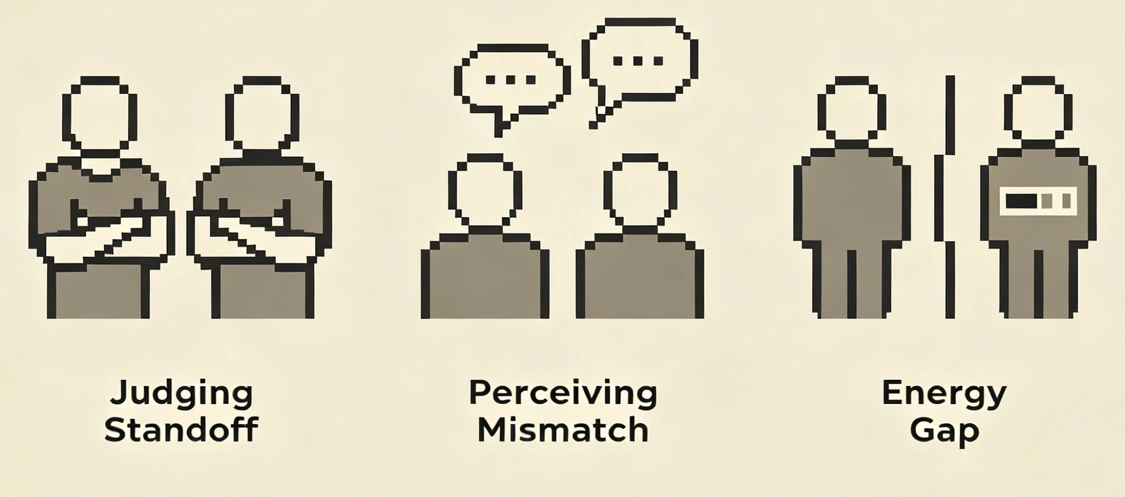
The most honest thing we can say about MBTI compatibility is that function overlap predicts ease, not success. Two people with identical function stacks will understand each other's mental moves immediately — and also have identical blind spots.
What actually predicts relationship quality is closer to: how well do you understand your own cognitive patterns? How curious are you about someone else's? Can you recognize when a difference in processing style is causing friction and name it as that, rather than as a character flaw?
A relationship between an ENFP and an ISTJ involves one of the most significant function stack differences possible — Ne/Fi/Te/Si versus Si/Te/Fi/Ne, nearly inverted. On paper, this sounds like maximum friction. In practice, people in this pairing frequently describe feeling like the other person "completes" something they were missing. The key variable isn't stack alignment. It's whether both people treat the difference with curiosity rather than judgment.
Cognitive function analysis gives you a more granular language for things that happen in relationships that four-letter codes don't fully explain. It doesn't give you a compatibility guarantee — nothing does. But it gives you something arguably more useful: a map of why certain frictions keep happening, and what each person would need to understand about themselves to navigate those frictions better.
If you want to see how your MBTI cognitive function patterns interact with a specific person's, our MBTI compatibility test goes beyond letter-matching to examine function-level dynamics. And if you're curious how MBTI fits alongside other compatibility frameworks, how MBTI compatibility testing actually works explains the mechanics in more detail.