Your Birth Moon Phase and Compatibility: What the Moon Looked Like When You Were Born
Not your moon sign — the actual shape of the moon at birth. Explore how your birth moon phase shapes your emotional rhythm, attachment patterns, and compatibility with others.
Why the Moon Phase at Birth Matters Differently Than Your Moon Sign
Everyone knows their sun sign. Many people now know their moon sign — the zodiac placement of the moon at their birth. But there's a third lunar dimension that almost nobody considers: the phase of the moon on the day you were born.
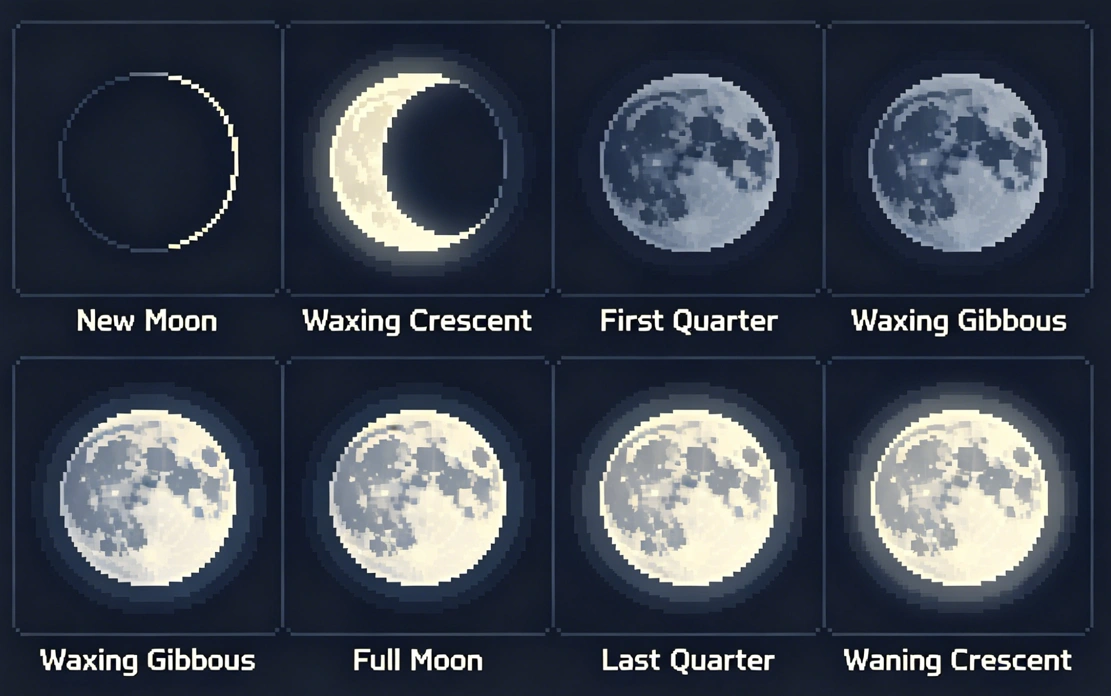
Not Scorpio moon or Pisces moon. Not "it's a full moon tonight." The actual shape of the moon — waxing crescent, first quarter, gibbous, full, waning — at the specific moment you came into the world.
This isn't a new idea. Astrologers have been working with natal moon phases for a long time. But it's had a revival recently, partly because it maps onto something genuinely interesting: different birth phases correlate with different orientations toward beginnings, commitment, visibility, release, and starting over. And when you look at two people's birth phases together, the combinations tell a different story than most compatibility analyses reach for.
Your moon sign describes the quality of your emotional experience — the flavor, the style. Scorpio moon processes emotion with intensity and privacy. Gemini moon processes through conversation and variety. Taurus moon wants stability and physical comfort before it can relax.
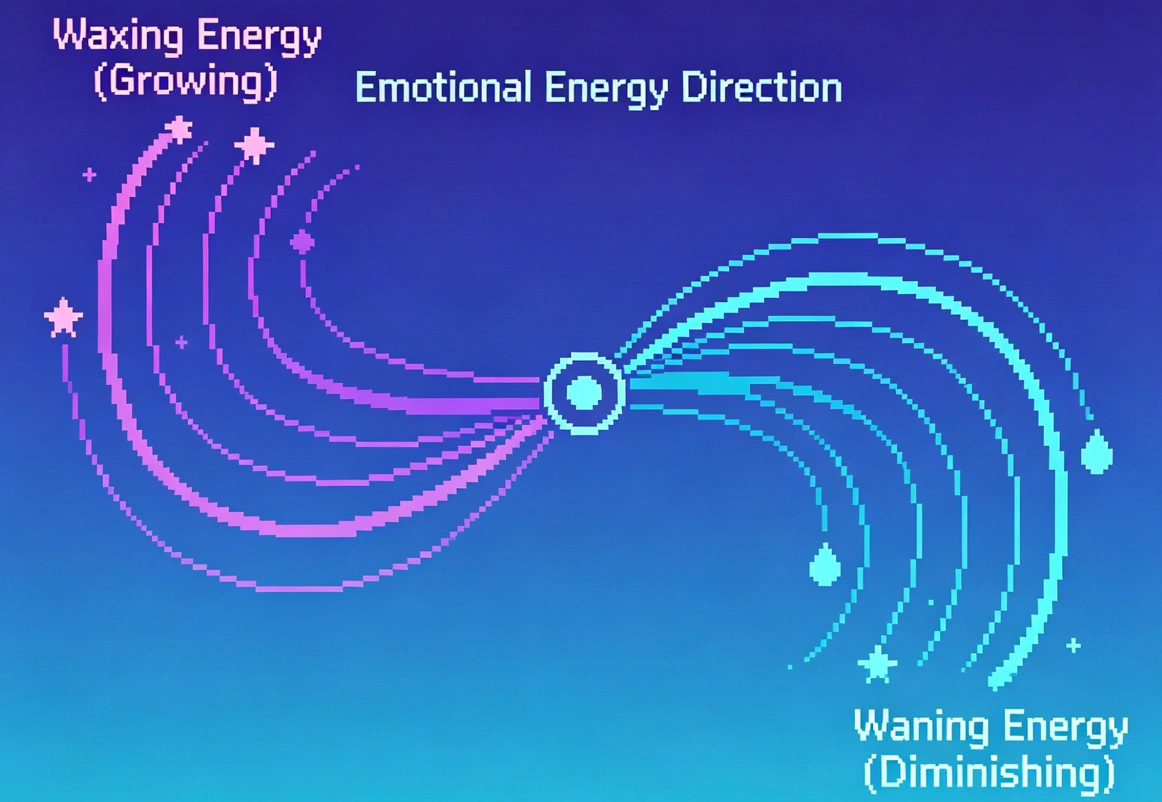
Your birth moon phase describes the rhythm of your emotional experience — when you expand, when you contract, when you need external validation, and when you need to go inward.
Think of it this way: your moon sign is the instrument you were born playing. Your birth moon phase is the tempo you naturally play it at.
Two people with the same moon sign can have completely different relationships to commitment, visibility, and timing — because they were born under different phases. And two people with very different moon signs can have a weirdly synchronized sense of pacing — because their phases align.
The Eight Birth Moon Phases
New Moon (0–45°): The Initiator
Born under a new moon — the sun and moon in conjunction, the sky dark — you came in carrying fresh-start energy. New moon people tend to have a strong instinctive drive to begin things. They're often good at launching, at projecting confidence before the proof arrives, at acting on vision before validation.
The shadow: finishing is harder than starting. Commitment can feel like closing a door on something better. In relationships, new moon people sometimes need a partner who can anchor the long game without making them feel trapped.
Waxing Crescent (45–90°): The Builder
The moon is small but growing. People born here often have a strong relationship with intention — they know how to build toward something, step by step. They're motivated by growth and tend to be persistent in ways that don't always look dramatic.
In relationships, crescent people often invest heavily in the early stages — putting in effort to establish something solid. They can struggle when a partner doesn't match their level of deliberate investment.
First Quarter (90–135°): The Challenger
The half-moon is a symbol of decision at a crossroads. First quarter people were born into tension — the moon pulling against the sun — and many of them carry a kind of productive conflict as a default mode. They're driven by challenges. They don't avoid obstacles; they tend to define themselves against them.
Relationships with first quarter people can feel energizing and slightly combative. They want a partner who can hold their ground. Agreeableness isn't particularly attractive to them; someone who pushes back is.
Waxing Gibbous (135–180°): The Refiner
So close to full — but not yet. Gibbous people were born with a sense of almost-there that can become a defining orientation. They're often highly self-critical, analytical, and dedicated to improving what they've already built. Perfectionistic streaks are common.
In relationships, this translates to a partner who notices everything and works hard to make things better — which is a gift, but can also drift into over-analysis or difficulty accepting "good enough."
Full Moon (180°): The Illuminator
The moon at maximum visibility, the sun and moon in direct opposition. Full moon people often have a heightened awareness of the tension between their inner experience and external expectations. They tend toward intensity, visibility, and extremes — relationships are rarely casual.
Full moon people often report that their relationships feel fated or unusually significant. They're drawn to meaning and depth. The challenge is that this intensity can be destabilizing — both for themselves and for partners who weren't expecting that level of charge.
Waning Gibbous (180–225°): The Communicator
Post-full, the moon begins to share what it's learned. Waning gibbous people often have a strong orientation toward teaching, sharing, and passing on what they know. They're generous with insight and tend to build relationships through communication and mutual understanding.
They may struggle when a partner isn't interested in the same level of verbal and intellectual processing. Conversations need to go somewhere real for them to feel connected.
Last Quarter (225–270°): The Releaser
The half-moon again, but moving toward darkness rather than light. Last quarter people have a natural capacity for letting go — of outdated frameworks, relationships that have run their course, beliefs they've outgrown. This can look like instability to people who value continuity, but it's more accurately described as a willingness to serve the future over the past.
In relationships, last quarter people often need partners who understand that their capacity for ending things isn't coldness — it's honesty. They don't linger where they know they shouldn't be.
Waning Crescent (270–360°): The Integrator
The thinnest visible sliver before darkness. People born here often carry a quality of completion — something ending, something preparing to begin again. There's frequently a sense of old-soul awareness, a gravitational pull toward quiet and introspection.
Relationships with waning crescent people often have an unusual depth and stillness. They're not particularly interested in novelty for its own sake. They want something real enough to stay with.
How Birth Phases Interact in Relationships
The most interesting question isn't "which phases are compatible?" It's: what does the phase combination create in the dynamic between two people?
Phase opposition (e.g., New Moon + Full Moon): These pairings often feel magnetic and slightly destabilizing. New moon's forward momentum meets full moon's intensity and reflection. Each can illuminate something the other was missing — but they need to be willing to sit with tension rather than resolve it prematurely.
Phase harmony (e.g., Waxing Crescent + Waxing Gibbous): Two people on the same arc — both building — often feel naturally synchronized. They understand each other's pacing without needing to explain it. The risk is that they can reinforce each other's blind spots rather than expanding each other's range.
Phase complement (e.g., First Quarter + Last Quarter): One person builds by challenging; the other builds by releasing. This can create an oddly effective balance where each person's orientation addresses what the other lacks. It can also be confusing until both people understand what the other is doing rather than just experiencing it as opposition.
Full Moon + any Gibbous: A combination that tends to produce high-intensity, high-processing relationships. Both orientations involve visibility and depth — the question is whether both people can sustain that level without burning out.
Birth Moon Phase and Attachment Style: An Unexpected Overlap
One of the more interesting threads in natal lunar phase interpretation is how closely the eight phases map onto patterns that modern psychology describes through attachment theory.
New moon people's ambivalence about commitment and tendency to act from pure vision before results exist overlaps meaningfully with what attachment researchers describe as the avoidant end of the anxious-avoidant spectrum — not coldness, but a strong internal need for autonomy and fresh-start energy that commitment can threaten.
Full moon people's intensity, the sense that relationships feel fated, and the heightened awareness of tension between internal experience and external reality maps closely onto the anxiously attached pattern — the gravitational pull toward deep meaning, the sensitivity to distance, the difficulty when a relationship stays at a surface level.
Waxing phases generally correlate with the more secure-leaning orientations: building, investing, trusting the process. Waning phases correlate with something harder to categorize — a kind of earned security that comes from having genuinely processed and released, rather than just being wired for stability.
This doesn't mean birth lunar phase causes attachment style. The overlap is a useful parallel, not a causal claim. What it suggests is that the emotional patterns captured in natal phase symbolism are real psychological patterns — they just get described with different vocabulary depending on whether you're reading an astrology column or a psychology paper.
For compatibility, the practical question becomes: do these two people's natural rhythms of bonding, building, and releasing create a sustainable dance, or are they pulling in directions that will eventually feel like opposition?
What Your Birth Moon Phase Doesn't Tell You
Birth moon phase analysis is most useful when it's understood as one layer of a larger picture, not a standalone compatibility verdict.
It says almost nothing about communication style — that's where moon sign and rising sign fill in more detail. It doesn't address core values, life goals, or the dozens of practical compatibility questions that determine whether two people can build a life together. And it doesn't override the actual experience of being with someone: the ways real conversations go, how conflicts get repaired, whether each person shows up consistently over time.
What natal moon phase analysis does well is offer a vocabulary for the rhythm layer of compatibility — the pacing, the cycle of expansion and contraction, the way one person's natural movement through emotional seasons meshes or clashes with another's. This is the layer that often goes unexamined, even in relationships where people are otherwise thoughtful about compatibility.
Two people who understand each other's natal phase rhythms have a language for "I'm in a contracting phase right now, I need to go inward" that doesn't require the other person to experience it as withdrawal. They have a way of explaining "I need to push forward on this, even though the timing isn't ideal" that isn't demanding — it's just naming where they are in their cycle.
That's a small thing that turns out to matter quite a lot over time.
Why This Differs From Standard Compatibility Analysis
Most compatibility frameworks — MBTI, zodiac sun signs, even attachment theory — describe what you are. Birth moon phase analysis describes when you are. The rhythm. The tempo. The natural cycle of expansion and contraction that you move through in every significant relationship.
This is why two people who score high on every other compatibility metric can still feel oddly out of sync: they're moving at different rhythms, through different phases of internal experience, without a common language for it.
It's also why some pairings that look unusual on paper have an ease that neither person can fully explain. Their rhythms match. They intuitively understand when the other person needs to push forward and when they need to retreat.
Birth moon phase doesn't determine whether a relationship will work. What it offers is a more nuanced description of how two people naturally move through time together — and whether their rhythms have room to breathe alongside each other.
If you're curious about how your birth moon phase interacts with a partner's emotional patterns, our moon phase compatibility test examines lunar emotional dynamics between two people. For a broader look at how moon phases factor into compatibility analysis, moon phase compatibility testing explores the framework in more depth.